A Remembrance Video of Mattie

Thank you for keeping Mattie's memory alive!

Dear Mattie Blog Readers,

It means a great deal to me that you take the time to write and to share your thoughts, feelings, and reflections on Mattie's battle and death. Your messages are very meaningful and help support me through very challenging times. I am forever grateful. As my readers know, I promised to write the blog for a year after Mattie's death, which would mean that I could technically have stopped writing on September 9, 2010. However, like my journey with grief there is so much that still needs to be processed and fortunately I have a willing support network still committed to reading. Therefore, the blog continues on. If I should find the need to stop writing, I assure you I will give you advanced notice. In the mean time, thank you for reading, thank you for having the courage to share this journey with me, and most importantly thank you for keeping Mattie's memory alive.


As Mattie would say, Ooga Booga (meaning, I LOVE YOU)! Vicki


July 31, 2018

Tuesday, July 31, 2018

Tuesday, July 31, 2018 -- Mattie died 463 weeks ago today.

Tonight's picture was taken in August of 2008. Mattie was outside in the Hospital commons area showing his cousins this amazing rock garden. I am not sure it was actually a garden, but let's put it this way..... there were a lot of stones surrounding the periphery of the medical library and all of them caught Mattie's attention. He loved to go look at the stones and I must say on two occasions, we left the garden with  stones in tow. You can see in this photo, Mattie was picking up stones and checking them out. One day during Mattie's treatment, and it was a very bad day, we went outside and Mattie came back to his room with a very large stone. Most of the time I was able to convince Mattie not to take a stone, but that day, if the stone brought him happiness, it was coming with us! This stone remains in our front hallway today, as we use it to prop our door on warm weather days. 


Quote of the day: I have learned now that while those who speak about one's miseries usually hurt, those who keep silence hurt more. ~ C. S. Lewis


I would imagine that the average person who interacts with me isn't aware of my chronic daily pain. Not just one pain, I have several. For 16 years, I haven't known a day without some sort of headache. I marvel at people who tell me they have never had a headache! That is pain number one. Then pain number two is from fibromyalgia, which is basically over active nerves that produce pain in the neck, back, arms and legs. If those two aren't bad enough, now I add pain number three..... I have a torn labrum. 

Peter went with me today to the orthopedic surgeon's office. The doctor I was referred to is considered the guru in labrum tears in Washington, DC. He performs about 8 surgeries on the labrum weekly. In any case, my appointment was for 3:30pm. When I arrived the receptionist told me they tried to call me but couldn't get a hold of me. They said the doctor was running late. So I asked what number they called, and of course they did not have my correct call phone number. Problem number one! Problem two was that the office staff did not manage expectations for patients in the waiting area.

When I asked the receptionist what late means.... I said late like my urologist which translates into 2-3 hours late, or 30-40 minutes late. She responded.... NO not hours, but maybe 40 minutes at most. Needless to say we waited over two hours. But we weren't the only ones. We started talking to other patients in the waiting area and befriended two. We shared stories, pains, and frustrations together, as well as questions we all wanted to ask the doctor. They were not happy waiting either and frankly we felt this wasn't managed well by the staff who did not level set our expectations from the beginning. Why tell us 40 minutes, when they knew it would be hours?!

Needless to say I went back up to talk with the staff two hours into waiting and told them I wasn't the only unhappy patient. Literally they left patients alone for so long that we formed a support group with each other. The staff got what I was saying and the next patient called back was me. I hate to say this but in healthcare, the loudest voice gets the most attention. It shouldn't be this way, but it is!

Fortunately the doctor was nice. Harried but nice. He explained that I have a significant labrum tear, in which the entire cartilage would need to be replaced. It gets replaced with an animal cartilage, not something synthetic. However, he feels that surgery should always be the last resort. Therefore I will continue on anti-inflammatory meds and do physical therapy two times a week for 12 weeks. He actually wanted to give me a cortisone injection in the hip today, but I said no. Given that I am going back to Los Angeles next week, I do not want to be deviating from my current med routine. So I will begin this regimen in late August and see him in September, for a cortisone shot. 

The doctor is uncertain how I got this, but believes it has been brewing for years given the calcifications that are growing around the tears. With that said, the goal is to reduce the inflammation. He thinks that if that gets reduced my pain will be less. He says that people can live with torn labrums, without having surgery. But the question is can I get to that point where the inflammation gets significantly reduced? Time will tell. I also asked him whether more activity can further the tear. The answer was yes. So until I am stabilized I can not do zumba and any high impact activities. Things I like to do and that help with fibromyalgia pain.  

So what's a labrum tear? 

A hip labral tear involves the ring of cartilage (labrum) that follows the outside rim of the socket of your hip joint. In addition to cushioning the hip joint, the labrum acts like a rubber seal or gasket to help hold the ball at the top of your thighbone securely within your hip socket.

Athletes who participate in such sports as ice hockey, soccer, football, golf and ballet are at higher risk of developing a hip labral tear. 

Symptoms

  • A locking, clicking or catching sensation in your hip joint
  • Pain in your hip or groin
  • Stiffness or limited range of motion in your hip joint

Treatment

Treatment choices will depend on the severity of your symptoms. Some people recover with conservative treatments in a few weeks, while others may require arthroscopic surgery to repair or remove the torn portion of the labrum.

Medications

Nonsteroidal anti-inflammatory drugs (NSAIDs), such as ibuprofen (Advil, Motrin IB, others) and naproxen sodium (Aleve), can relieve pain and reduce inflammation. Pain can also be controlled temporarily with an injection of corticosteroids into the joint.

Therapy

A physical therapist can teach you exercises to maximize hip range of motion and hip strength and stability. Therapists can also analyze the movements you perform that put stress on your hip joint and help you avoid these forces.

Surgical and other procedures

If conservative treatments don't relieve your symptoms, your doctor may recommend arthroscopic surgery — in which a fiber-optic camera and surgical tools are inserted via small incisions in your skin.


July 30, 2018

Monday, July 30, 2018

Monday, July 30, 2018

Tonight's picture was taken in August of 2008. By that point, Mattie was a month into treatment. That weekend, Mattie's cousins from Boston visited him. It was a lovely day, so instead of sitting in the hospital room, we asked Mattie's nurse, Miki, if we could go outside the building on the second floor commons area. Miki understood immediately the importance of having this outside time and time to connect in a less threatening environment. The decision to go outside was great for us, but for Miki that meant more work. As she had to set a timer to come down the elevator and outside to check Mattie's IV and take his vitals periodically. We will always be grateful to Mattie's outstanding nurses who understood that effective care had to be delivered in a compassionate and humanistic manner. 


Quote of the day: You know, once you’ve stood up to cancer, everything else feels like a pretty easy fight. ~ David H. Koch


This weekend, I received an email from a cancer friend in Canada. He asked whether I could retrieve an article for him. What am I talking about? Well most of us have access to articles in newspapers and magazines. But scientific or peer review articles are materials that are harder to find. Why? Because in order to read such research, you need to have a way to access these journals. Certainly one could go into a public library and work that route. But what an educational/research institution has access to will far surpasses what you can get in your neighborhood library. 

It is thanks to one of the faculty members at my alma mater, The George Washington (GW) University, that I will have indefinite access to their on-line library collection. A gift that is hard to put a price tag on, because we couldn't afford such a yearly subscription to all these databases as a private citizen. GW considers me a permanent visiting scholar, which enables me to access scientific articles from all around the world. I am not sure why GW has done this for me. It could be my years of service at the University, as I did a lot of work there during and after I completed my PhD. Or perhaps some of the faculty are in support of the work that the Foundation does and understands in order to continue this research, I need access to peer review materials. Which ever the reason, I am grateful. 

So when my friend wrote to me on Sunday, within minutes I was able to search GW's system and I downloaded the article for him. The article was entitled, Family Is Who They Say They Are: Examining the Effects of Cancer on the Romantic Partners of Adolescents and Young Adults (to see the abstract:
http://journals.sagepub.com/doi/full/10.1177/1074840718786985). It is amazing to me that with a couple of clicks on the computer, one can have access to so much material. As I remember when working on my doctorate, so much involved visiting the university library, searching for actual journals in the bookshelves, and making xerox copies of articles to read at home. GONE are those days! In fact a student never has to leave the comfort of one's home anymore to write a research paper. 

I love when people send me links to articles, because what I usually do is skim or read them. It exposes me to more material than I may find on my own. What was intriguing about this article was it focused upon the psychosocial consequences of the romantic partner. A partner involved in a relationship with an adolescent or young adult who has cancer. Typically only the child/teen and family members have been the focus of research. But this article makes a very valid case for why this circle needs to be expanded because there is a profound effect on the partner. 

The article discussed in length why some romantic relationships are severed with a childhood cancer diagnosis (e.g., the diagnosis is just too much for the partner to manage and walks away) and some remain intact (e.g., the partner felt as if he/she was embraced by the family and loved this special connection and bond). As I was reading this article the first thing that dawned on me was that this research applies to friends too. Not just romantic partners. I lost many friends during Mattie's journey, and though I don't dwell on it, a part of me always wonders? I wonder, how did my friends walk away from our long term friendship because what I was dealing with was too much for others to handle emotionally? 

I have no answers. The article talks about not judging those who walk away. Of course they are specifically talking about teenagers who are walking away, and I am talking about adults. I can try to be empathetic and not to judge their actions but it leaves me wondering as to the quality and depth of those relationships. 

July 29, 2018

Sunday, July 29, 2018

Sunday, July 29, 2018

Tonight's picture was taken in August of 2008. Mattie was in his first month of treatment, yet his art therapists already knew what he liked to do at the art table in the outpatient clinic. They understood he loved Scooby Doo. So they literally traced a Scooby Doo scene on a ceiling tile and invited Mattie to paint it in. This was a project that all three of us did together and when it was done, the tile went up on the ceiling of a clinic room. Mattie spent many hours in that clinic room not feeling well, so we had ample time to admire his artistic style. But the point to the story was the role art played in our lives during treatment. It kept us talking, working together, and was an outstanding diversion from dealing with the stress of cancer. 


Quote of the day: Art can permeate the very deepest part of us, where no words exist. ~ Eileen Miller


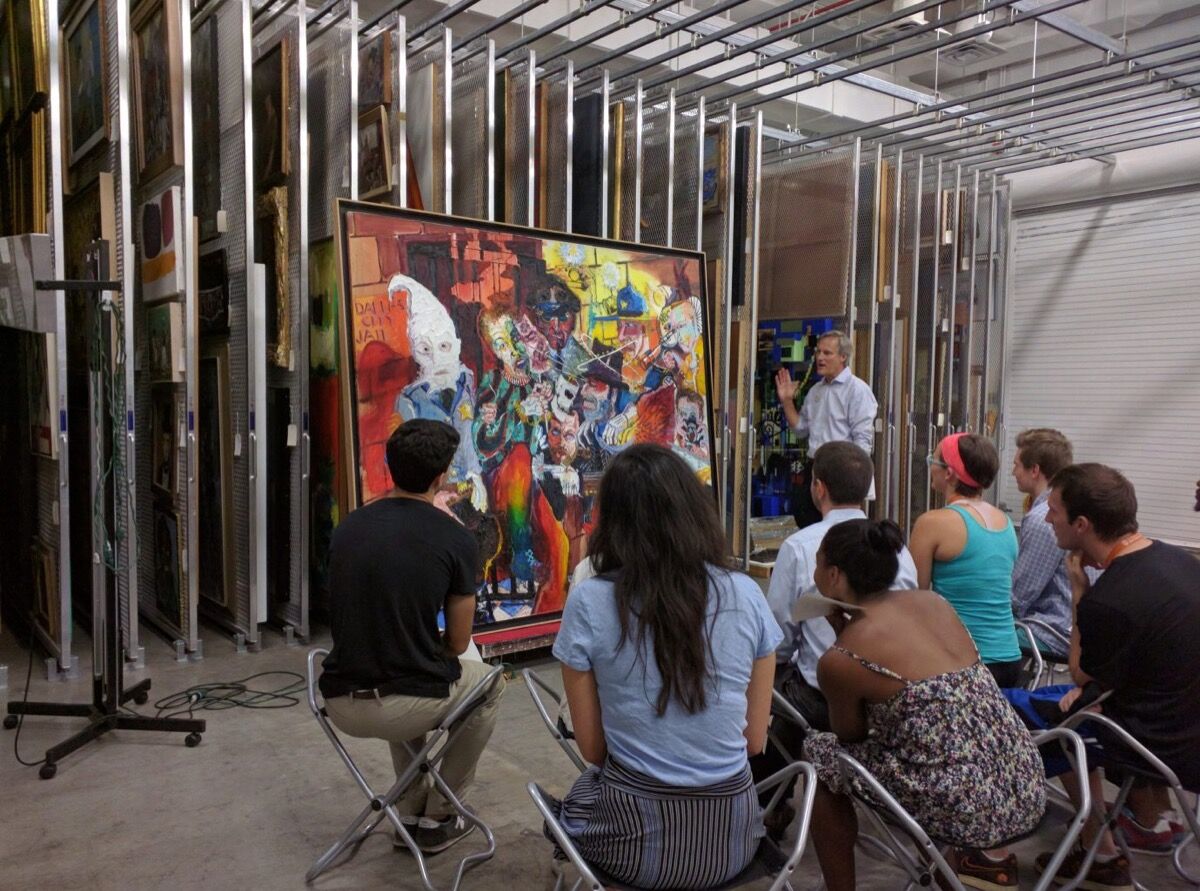
First-year medical students discussing Dallas Chaos II (1982) by Peter Dean, Blanton Museum of Art. Photo by Siobhan McCusker.
About two weeks ago my lifetime friend, Karen, sent me a link to an article entitled, Why Med Schools Are Requiring Art Classes. Naturally the title was intriguing, and I imagine Karen sent it to me because I have taught art to several different kindergarten classes at Mattie's school, after he died. In addition to that, Karen knows of my intense experience with the 
medical profession. 

If you wish to read this article for yourself, click on:
https://www.artsy.net/article/artsy-editorial-med-schools-requiring-art-classes


Certainly we aren't going to our physicians for their knowledge or perspective on art. But that is not why art is being integrated into medical curriculum. Instead, through viewing, creating, and interpreting art, medical students have been found to develop better communication with patients by developing insights on subjects like mental illness and cognitive bias.

I think there are many reasons why the human component of medicine has been removed from the profession. One reason is for self preservation purposes. If doctors separate themselves from the person, then it becomes a whole lot easier to just look at data and facts and treat that accordingly. After all dealing with human emotions and reactions to treatment is time consuming and labor intensive. However, without understanding the person's thoughts, lifestyle, and feelings, it becomes very hard to effectively prescribe and treat a person medically. Another reason is students are rewarded in their medical training for being dispassionate and neutral and are flagged when they spend too much time with their patients talking. Third, the sheer fact of timing and demand must be factored in. Doctors are expected to see a countless number of patients in a short period of time, making it logistically impossible to get to observe and listen to patients. In fact, health insurers reward doctors for doing just that.... seeing patients and arriving at a diagnosis quickly. 

In a medical training program at Penn State, art has been a part of their curriculum since the 1960's. It was the first medical school in the Country to provide such holistic experiences. For example, in a course at Penn State, one student is given a postcard with a famous Impressionist painting on it, while the other student, who cannot see the card, stands at a canvas with a paintbrush in hand, and must ask their partner questions about the painting in order to reproduce it. The painter becomes like the physician who’s taking a history and trying to get information from the patient. They experience firsthand how much easier it is to gain information when you ask open-ended questions, when you stop and let that patient tell their story.

When Dr. Flanagan (a professor at Penn State who teaches fourth year med students) was interviewed, he said, "it’s not just a nice idea to incorporate humanities into medical schools to make the education more interesting. It’s protecting and maintaining students’ empathy so that by the time they go off to practice medicine, they’re still empathetic individuals.” He notes that while medical students traditionally enter their first year with very high levels of empathy, after three years, research has shown, the exposure to content around death and suffering can cause those levels to plummet. Engagement in the humanities can rectify this problem.

At the most basic level, these exercises in close observation help to improve diagnostic skills—priming students to identify visual symptoms of illness or injury in patients, and (hopefully) preventing them from making misguided assumptions. But it’s also about delving beneath face value. I am pleased to hear about the integration of art into medical curriculum, because my experiences with healthcare clearly illustrates that something is just NOT right. There is a huge disconnect from doctors and their patients and I believe doctors miss over 75% of what is going on with a patient because the doctor doesn't spend the time getting to know the person in front of them. 

In addition to a diagnosis and treatment issue that can result from this lack of communication, the issue of trust and adherence to treatment also comes into play. If we feel like our doctor isn't listening and getting to know us, how compliant will we be with his/her orders? The answer is compliance/adherence is severely impacted. 

Overall, I can count on one hand the number of doctors I have experienced in my lifetime who take the time to listen and have empathy and compassion. What rolls around in my mind is the countless times Mattie complained of pain while in the hospital. Instead of the majority of doctors taking it seriously, they instead told me.... It's not possible. They pronounced that Mattie was either addicted to pain meds or was manipulating me. At the end of the day, they were VERY wrong. I wonder if they ever reflect back on their poor behavior with me or their clear misjudgment???? I am sure not!!! But that's a problem. No reflection, no processing, and no learning from one patient to another. Frankly I am not sure an art class can change this! You can train a person to learn skills, but you can't train a person to be HUMAN. You either have it or you don't and in my opinion the medical profession sifts out those who have this humanistic quality. 

July 28, 2018

Saturday, July 28, 2018

Saturday, July 28, 2018

Tonight's picture was taken in July of 2009. Mattie was outside on our deck and playing in his sandbox. Keep in mind that Mattie had a broviac. This was a central venous catheter inserted into the large vein leading directly into Mattie's heart. But the catheter had two tubes hanging from Mattie's chest. Any time Mattie was playing or near water and sand, I worried about these catheters. Because if pulled hard, Mattie would instantly bleed out and die. Of course if the catheters got dirty, that was also a breeding ground for an infection. Of course any infection would have an impact on the timing of chemotherapy administration. So it was a fine balancing act for us to monitor Mattie versus us allowing Mattie to be a child with moments of normal and fun. 


Quote of the day: A hero is someone who has given his or her life to something bigger than oneself. ~ Joseph Campbell


This week, Peter came across an article that was being promoted on-line. The article was in Scientific American. What caught Peter's attention was the title of the article. So naturally he read it and then forwarded it along to me. When Peter emailed it to me, he wrote...... "we need to follow up on this!"

With that note, I was inspired to quickly read the article and to determine what Peter saw that needed to be corrected. He did not even have to tell me, that's how blatant the oversight was. What was missing from the article? There was not even a mention of our evidence based Psychosocial Standards of Care for Children with Cancer and Their Families. Which is a problem because the article charges its readers to advocate for psychosocial care as a Standard of Care. Which one can only conclude means that this is NO STANDARD currently exists. 

I encourage you to read the article, Understanding the Psychological Effects of Childhood Cancer. It can be found by clicking on this link:  

https://www.scientificamerican.com/article/understanding-the-psychological-effects-of-childhood-cancer1/


The opening paragraph, states, "Thanks to advances in treatments, the overall survival rate for childhood cancers has increased from 10% a few decades ago to nearly 90% today." I am not alone in my disdain for this misleading fact. In fact, I have been at conferences before where parents stand up and actually confront the researchers and correct them! Who is right? Parents of course. 

This is a table generated by the American Cancer Society that specifies the five year survival rate for different forms of childhood cancer. What you will immediately notice is that ONLY a few childhood cancers have a high survival rate. Cancers like Mattie's, have a 71% survival rate, which means that 29% of children don't survive. 

I truly wish we could get scientists and clinicians to converse about the REALITY!!! Putting that aside, at the end of the article the author states, "In addition to pushing for cures for cancer, we should also advocate for psychological support as a standard of care for childhood cancer. This means having social workers, therapists, and Child Life advocates as a part of the treatment team, and with the family every step of the way."

As soon as I read the article, I googled the author, Dr. Hilary Marusak, who is a neuroscientist and a frequent contributor to Scientific American, and obtained her email address. Within minutes, I wrote this to her:

Dear Dr. Marusak,

I wanted to write to you today to let you know that I was very pleased to see your article entitled, Understanding the Psychological Effects of Childhood Cancer in Scientific American.  You brought up excellent points, particularly regarding childhood cancer being more than a medical disease. 

My husband and I lost our only child, Mattie, to osteosarcoma in 2009. Two months after he died we established the Mattie Miracle Cancer Foundation. The mission of Mattie Miracle is to enhance awareness of the psychosocial impact of childhood cancer and increase access to psychosocial services for children and their family members. As our tagline indicates, we learned first hand that childhood cancer "IS NOT JUST ABOUT THE MEDICINE." Mattie developed clinical depression, anxiety, and medical traumatic stress while on treatment, and had no mental health issues prior to his cancer diagnosis.

We live in Washington, DC and support direct psychosocial services, by funding child life professionals at two local hospitals. In addition to our local work, we have been working with a team of psycho-oncologists from around the US, Canada, and the Netherlands since 2012. Mattie Miracle had the vision to create evidence based psychosocial standards of care and with Dr. Lori Wiener's leadership at NCI, the Standards were published in a dedicated supplement of Pediatric Blood & Cancer in December of 2015. I wanted to write to you today because I know you mentioned the following in the article..... "in addition to pushing for cures for cancer, we should also advocate for psychological support as a standard of care for childhood cancer." I am happy to tell you that what you are suggesting already exists and like you, Mattie Miracle wholeheartedly supports this initiative to expand the message about comprehensive cancer care including psychosocial support. 

The Psychosocial Standards of Care for Children with Cancer and Their Families were developed over a three year time frame, involved 85 health care professionals from 44 institutions across the U.S., Canada, and the Netherlands. The project resulted in the largest and most comprehensive psychosocial standards research study to date in which 1,217 journal articles were reviewed.  These historic evidence-based standards define what children with cancer and their families must receive to effectively support their psychosocial needs from the time of diagnosis, through survivorship, or end of life and bereavement care.  The Standards have been endorsed by 16 professional organizations: 1) American Academy of Child & Adolescent Psychiatry (AACAP), 2) American Childhood Cancer Organization (ACCO), 3) American Psychological Association's Society of Pediatric Psychology (SPP - Division 54), 4) American Psychosocial Oncology Society (APOS), 5) Association of Pediatric Hematology/Oncology Educational Specialists (APHOES), 6) Association of Pediatric Hematology/Oncology Nurses (APHON), 7) Association for Pediatric Oncology Social Workers (APOSW). 8) American Society of Pediatric Hematology/Oncology (ASPHO), 9) B+ Foundation, 10) Canadian Association of Psychosocial Oncology (CAPO), 11) Cancer Support Community, 12) Children's Cause for Cancer Advocacy (CCCA), 13) Children's Oncology Group (COG), 14) CURE Childhood Cancer, 15) National Children's Cancer Society, and 16) St. Baldrick's Foundation. 

Currently the team is working on strategies to implement these Standards around the Country. We welcome any questions you may have about the Standards. Given your own work to help children cope with cognitive late effects, I thought you would appreciate having access to the Standards. Mattie Miracle has paid for indefinite open access to the Standards because we are passionate about changing the way cancer care is delivered to children and their families.  For we know all too well that the psychosocial issues DO NOT end when the treatment does. Below you will find some links to the Standards that you may find helpful. Thank you for all the work that you do and for calling attention to the psychosocial aspects of cancer care. In appreciation, Vicki

Helpful Links:

Standards
History
Read Them
Endorsements
Standards Update
Implementation
---------------------------------------------------------------

Hilary wrote me back the next day and was very gracious. She let me know that she knew about the Psychosocial Standards of Care and was sorry for our loss. She then asked how she could help with the implementation process of the Standards. So I asked her whether she could write a follow up article for Scientific American highlighting the Standards and letting her audience know that Psychosocial Care is part of a Standard of Care and how advocates can ensure this by promoting these evidence based Standards. Hilary replied that she would be happy to, but that we had to check with the magazine's editor. So with that, I wrote the below email to the editor:

Dear Mr. Cook,

I received your email address from Dr. Hilary Marusak. You published a great article of hers entitled, Understanding the Psychological Effects of Childhood Cancer in Scientific American. As I said to Hilary, it is wonderful to see the psychological impact of cancer highlighted in such a well read and prestigious publication. 

I included my email trail with Hilary below so that it would help you put what I am writing into context. In a nutshell, my husband and I are childhood cancer advocates and run a non-profit called the Mattie Miracle Cancer Foundation. The Foundation was created two months after our only child, Mattie, lost his battle with Osteosarcoma. What we learned from Mattie is that "Childhood Cancer is NOT just about the medicine." In fact, there are real life psychological issues that arise from the treatment and the cancer experience in general. Which is why Mattie Miracle's mission is to enhance awareness of the psychosocial issues associated with childhood cancer and increase access to psychosocial support for children with cancer and their families. 

Naturally Hilary's article captured us as soon as we saw its title. In the article Hilary mentions....."in addition to pushing for cures for cancer, we should also advocate for psychological support as a standard of care for childhood cancer." The reason I reached out to Hilary was I wanted to make sure she was aware of the Psychosocial Standards of Care for Children with Cancer and Their Families which were published in Pediatric Blood & Cancer in December of 2015. These historic evidence based Standards were the vision of Mattie Miracle and their development was led by Dr. Lori Wiener at NCI. I have included links and more information about the Standards below. 

It is my hope that you will consider Hilary writing a follow up piece to her article highlighting the Standards, Standards which she is advocating for as being part of comprehensive cancer care. Psychosocial support as a Standard of Care is exactly why these Standards were created. It would be wonderful to share this amazing three year long research project involving over 85 psycho-oncology professionals from the US, Canada, and the Netherlands to develop Standards that will ensure optimal psychosocial care for children with cancer and their families from the time of diagnosis, throughout treatment, and into survivorship or end of life and bereavement care. 


It is an honor to e-mail a Pulitzer prize winner and we thank you for your time and consideration to this request. We believe that highlighting the Standards in your publication will enable us to reach a much larger audience to spread awareness of the importance of these Standards of Care and how the Standards can change the direction of cancer care in our Country.  In appreciation, Vicki

--------------------------------------------------------------

The editor did write me back in a very timely fashion, but here was the response:

Dear Vicki, 

Thank you for your kind note and for your important work on this issue. Unfortunately, it is not going to work to have a follow up post, but I wish you luck and appreciate your efforts. 


I am not sure your reaction to the above response, but mine was wow! I just explained that I lost my child to cancer and the work we are doing with the Foundation. Yet there was NO acknowledgment to either. Which to me is very telling. But what surprises me is that as the editor of his publication he isn't interested in correcting this oversight in any way. Which means to me that he truly has no interest in the content he was publishing in the first place. Why aren't facts of a story important anymore? This is a rhetorical question! But what this tells me very BOLDLY is that the advocacy work Peter and I do is needed if we ever are going to make any headway with psychosocial support being incorporated into comprehensive cancer care. 

July 27, 2018

Friday, July 27, 2018

Friday, July 27, 2018

Tonight's picture was taken in July of 2009. As you can see Mattie was in the out-patient physical therapy clinic at the hospital. Whether Mattie was in the hospital or out of the hospital, starting in the Spring of 2009 he was consistently doing physical therapy. Remember the goal back then was to retrain Mattie to walk so he could return to school. We had no idea that we would be facing a terminal diagnosis the following month. In this photo, Mattie was sandwiched between Anna (his therapist) and his close buddy in cancer (Brandon). Brandon was diagnosed with cancer around the same time as Mattie, so they went through treatment together. Even after Brandon's treatment was completed, he would come back to the hospital on a regular basis to visit Mattie. A true friend!


Quote of the day: The most courageous act is still to think for yourself. Aloud. ~ Coco Chanel


I think Coco Chanel's quote is brilliant and spot on. This year Mattie Miracle launched two research grants. One hosted through the Association of Pediatric Hematology/Oncology Nurses (APHON) and the other through the American Psychosocial Oncology Society (APOS). For more info on the Mattie Miracle APOS grant, go to: Mattie Miracle Grant

For several weeks now, I have been reviewing proposals. Keep in mind that we originally received over 20 grant applications, and from there we whittled it down to 12. From that 12, we had to select one. This one recipient will get a $10,000 grant to conduct a study that will help implement the Psychosocial Standards of Care for Children with Cancer and Their Families. 

Because the grant is administratively handled through a professional association, the association has a research review committee which evaluates the scientific rigor of the proposals. However, the condition on any of Mattie Miracle grants is the simple fact that we want access to all the proposals, all the rating criteria, and decisions. 

This week, I began to see what the committee deemed important and top quality research to fund, wasn't in line with my thinking. Typically I am on the same page with this group of professionals, who I have worked with many since 2012. So when I realized that we weren't, I truly wasn't sure how to handle it. 

Never however did I waiver in my feelings about the research. I wasn't swayed by their evaluations what so ever. Instead I would say I was getting frustrated and as Peter knows, when I get frustrated, I can sit with that for a long time, until I simply get mad and then have to do something about it. 

I think this is where I differ from a pure researcher. I think research is important but not because it generates more questions and MORE RESEARCH. To me research has to produce something meaningful that will help guide clinical care. So in essence the research we wish to fund must be able to provide a model, an intervention, or strategy that will help other cancer treatment sites implement the Standards of Care. So what did I do about this conflict of difference?

Given the top leaders in the field evaluating these proposals, one could have been intimidated and therefore compliant. That's not me. So onto option two. Option two was I wrote an email to the entire review committee last night and in a professional manner explained my point of view. I felt that the committee had to hear directly from me. I wasn't going to deliver this message any longer through an intermediary. Want to know the result of this group email?

The result was I helped the committee streamline their decisions today and they thanked me for my clarity and were eager to continue working with us. So the moral of the story is to always stick with what you believe in and don't be afraid to speak ALOUD. As I mentioned to the researchers, I have the lived experience with childhood cancer and this gives me insights about what will and will not work when designing studies for this population. If ever in doubt, teacher Mattie is a live and well in me!

July 26, 2018

Thursday, July 26, 2018

Thursday, July 26, 2018

Tonight's picture was taken in July of 2009. I absolutely LOVE this photo. Mattie received this Sponge Bob figurine from a friend and Mattie decided to pose for the camera and give me his best Sponge Bob impression. Mattie knew I wasn't a Sponge Bob fan, which maybe what inspired him to like the cartoon character even more. 

Quote of the day: Parting is all we know of heaven and all we need to know of hell. ~ Emily Dickinson


Peter and I drove to Baltimore today to present a $45,000 check to Children's Hospital at Sinai. This is the second hospital we have endowed a Mattie Miracle Child Life Program Fund. Pictured with us from left to right are:

Dr. Aziza Shad (one of Mattie's oncologists, who actually was on call during Mattie's death) and Dr. Jonathan Ringo (President of Sinai Hospital)

When I was asked where we wanted to have the check presentation, I immediately said the child life playroom. The playroom always meant the most to Mattie when he was in treatment at Georgetown University Hospital. Also since we are funding a child life position, it makes sense that we embrace where this professional will be working. You will notice I was holding a photo of Mattie in this picture and our Snack and Item Cart was beside me. 

At the presentation Dr. Shad said something as did Dr. Ringo. Then I spoke on behalf of the Foundation. Given that this hospital never met Mattie, the only way I can bring him alive to for them is through my stories and conversation. 

Pictured from left to right:
Joanne Lanzo (Director, Division of Pediatric Hospital Medicine), Laura Cohen (Child Life Coordinator), Susan Daw (Director of Women's and Children Services), Dr. Aziza Shad (Chief of Pediatrics), Dr. Jonathan Ringo (President of the Hospital), Peter, Vicki, Kristen Mylotte (Child Life specialist) and Kelly Beck (child life specialist)

No check signing would be complete without Mattie cupcakes. Of course NO ONE at this hospital knew our cupcake story, so I had to explain it. When Mattie was managing with cancer, he rarely ate. So when he requested any sort of food, we gave it to him. Mattie was motivated by cupcakes. They were incentives to complete physical therapy. Which is why cupcakes are always present at our events. They mean that Mattie is with us! Notice the butterfly sugar candies on top of each cupcake. Everyone thought I bought these cupcakes today. On the contrary I baked all of them on my birthday!

After the check presentation, we pushed around the Snack and Item Cart with the child life staff. I had done this once before at the Hospital, but it was Peter's first experience today at Sinai. The staff enabled us to meet children and families and hear direct feedback about the Cart.  
Me with a dad! His child was asleep in the room, but apparently his daughter loves the Cart and really wanted to meet us. 
This young lady's name is Victory. The photo doesn't do her justice, as she has a smile that lights up a room. She wasn't feeling great today and really wanted no visitors. Until she heard that it was us with the Cart. Her mom said Victory hasn't smiled all day, until she got to see the candy on Cart. 
This is Isabella and her mom. Isabella was not happy today as she had to get a blood draw involving needles. Like Victory's mom, Isabella's mom told me the same thing. She said the Cart is the one thing that consistently provides her daughter with smiles. 
This is Noam and his mom. Another cutie with a great smile. You want to know what excited Noam? Try a blue toothbrush. He was thrilled to be able to pick one out the basket, not to mention filling up a bag filled with treats. 

July 25, 2018

Wednesday, July 25, 2018

Wednesday, July 25, 2018

Tonight's picture was taken on July 25, 2009. The last birthday I celebrated with Mattie alive. That day, he designed a lovely lighthouse birthday card for me with the help of my in-laws. Mattie knew I loved lighthouses, and I think with more time, he would have been just as fascinated with them as I am. 

But check out that smile! I honestly do not know where Mattie found the energy or inner happiness to smile. Given all he endured and the fact that cancer was rapidly spreading throughout his body, he was absolutely amazing. 


Quote of the day: The secret of staying young is to live honestly, eat slowly, and lie about your age. ~ Lucile Ball


Another gray and rainy day in DC! This marks 5 days in a row of this delightful weather. Peter took me out to lunch at Fiola Mare today. This restaurant is very close to where we live. So we literally walked to lunch alongside the Potomac River. Thankfully while walking, there was no rain. 
We had a lovely waiter today who was efficient and not obtrusive. Which has happened to us once before at this restaurant. But the food and setting are so special. 
We had a lovely four course lunch. Peter started with a stone fruit salad. Are you aware of stone fruit, being cherries and peaches, or any fruit with a  pit? Any case, Peter had a salad and I had gazpacho. 


Then we got their famous lobster ravioli to split. 
Peter had scallops and I had halibut. As you can see I ate most of it before I remembered to snap a photo of the dish. It was delicious. 
For dessert we had a lemon spumoni, a dessert with bing cherries and ricotta gelato, as well as their complimentary birthday dessert. Lunch was my favorite part of the day! It was a lunch to remember. 
Meanwhile, tomorrow we are going to a check signing party at Children's Hospital at Sinai. For every check signing we have ever done, I always bake cupcakes. 

Mattie loved cupcakes while he was undergoing cancer treatment. In fact, we used the cupcakes as incentives to do physical therapy. So by bringing cupcakes to our check signings, Mattie is always with us. 
This year I found sugar shaped butterflies. So I added them to the top of the cupcakes. As my loyal readers know, butterflies are the symbolic creatures in nature that remind me of Mattie. 

July 24, 2018

Tuesday, July 24, 2018

Tuesday, July 24, 2018 -- Mattie died 462 weeks ago today.

Tonight's picture was taken in July of 2008. Mattie was diagnosed with cancer on July 23, and the following week, he underwent a bone biopsy. Which is why you can see Mattie and I examining his bandage. The only way that osteosarcoma becomes a confirmed diagnosis, is through a biopsy. Even a week into his diagnosis, Mattie was becoming traumatized. He was poked and prodded endlessly and also endured MRI's and other scanning without sedation. 


Quote of the day: Youth is happy because it has the ability to see beauty. Anyone who keeps the ability to see beauty never grows old. ~ Franz Kafka 


I went out to lunch today with my friend Tina. Tina wanted to celebrate my birthday. It was pre-birthday lunch and we had a wonderful three course experience at Chez Billy Sud, which is a charming french cafe in Georgetown. Tina and I are both foodies, so eating together is a fun experience. Because food is important to us. 
We both started with this chilled summer soup of corn. When I tell you it was incredible, I am not kidding. 


My entree was this wonderful trout. Actually I like trout in general, but this dish was absolutely incredible. 
We ended the meal sharing this incredible lemon olive oil cake. It may not sound good, but it was amazing. It was served with creme fraiche ice cream which was delicious. 

I have to say that even though it was another gray and rainy day in DC, having a memorable lunch made the day less blue. 

July 23, 2018

Monday, July 23, 2018

Monday, July 23, 2018

Tonight's picture was taken on my birthday, July 25, 2008. Two days after Mattie was diagnosed with cancer. I will never look at July 23, diagnosis day, the same way. I can recall the feeling of intense stress and anxiety after the diagnosis, so much so that both Peter and I had trouble sleeping for days. It was like some sort of switch went on in our bodies and we began working at an intense level like no other imaginable. 


Quote of the day: Grieving the loss of a child is a process, it begins the day your child passes and ends the day the parent joins them. ~ B.J.Karrer


I can't believe that ten years ago today Mattie was diagnosed with cancer. To me it seems like it was just yesterday. Yet the world keeps revolving and progressing forward, but we partially live in the past..... remembering. It doesn't matter how much time goes by, July 23 immediately transports us right back to Virginia Hospital Center, where Mattie was diagnosed.

Ask anyone who was diagnosed with cancer, the specifics of the moment they heard the news.... and you will definitely hear a story. It is something that is burned into your memory forever. In Mattie's case, I took him to the pediatrician on July 23, 2008, thinking he had a sprain or pulled a muscle in his arm from tennis camp. Thankfully the doctor took our complaints seriously and ordered an x-ray on the spot. The x-ray took forever to complete and I was irritated with the technician. After the x-ray, the technician told me we had to wait in a holding room. It never dawned on me why! In that holding room were other patients, all adults. There was a telephone in the room and it began to ring. NO ONE approached the phone to answer it, so I did.

A radiologist on the other end of the phone asked me my name and whether I was Mattie's mom. When I said yes, he told me I had to go right back to the pediatrician's office. I did not like that answer or his tone, so I told him I wasn't moving until he told me what he saw on the x-ray. It was at that moment, on the phone with Mattie and strangers watching me, that I learned Mattie most likely had Osteosarcoma. To this day, I still HATE phones and talking on them.

You maybe asking why was it Christmas for us on July 23rd? It was Mattie's idea! Right after being diagnosed, on our way home from the hospital, we asked Mattie what he wanted to do. He requested getting out all of our outdoor Christmas lights to decorate our deck. When your child is diagnosed with cancer, it is amazing what you will agree to and do!


On this 10th anniversary of Mattie's diagnosis, we remember our beautiful 7 year old who died too soon....who was brilliant, gifted, creative, and always humorous!


Today, I returned to the scene of the crime. The place where Mattie was diagnosed with cancer. I did not go back for nostalgia, I went for a mammogram. I am not sure why I booked this test on this anniversary date, but clearly I wasn't thinking. Never the less, they say that there is a high incidence between boys who get osteosarcoma and their moms who develop breast cancer. So I don't miss my yearly scan. 

You see that front entrance in the above photo? Well it was at that entrance that I met Peter, the day Mattie was diagnosed with cancer. I literally text messaged him at work and told him he had to get to the hospital as soon as he could. I text messaged him..... "Mattie has C." I literally couldn't write the word cancer back then!


Meanwhile this evening, I had a lot on my mind. I had Sunny in tow with his filled poop bag in one hand, along with my cell phone and his leash in the other. As I went to throw out the poop bag, I accidentally flung in the bag and my cell phone. As soon as I recognized what happened, I started screaming. Sunny did not know what was wrong! I quickly got him back home and I ran downstairs to our front desk for help. Thankfully we know all the staff that work at our complex. They mobilized quickly and had a maintenance worker come with me to our dumpster. However, they prepared me for the fact that the phone probably broke going down the shoot over three floors. If it did not break then it most likely would get compressed by the trash compactor which consolidates the trash in the dumpster. 

My phone is important to me and the thought that it broke or was shattered into pieces was too much to handle. Any case, my new hero is Jose. He went with me to the dumpster. He opened up the door of the dumpster and I had him look first. I couldn't bear to see the reality. When he told me it was absolutely fine to look, I was stunned. There was the phone..... just sitting there. No garbage around it, not a scratch or a ding. It was sitting there waiting for me to pick it up. I view this as my birthday miracle for the week!

July 22, 2018

Sunday, July 22, 2018

Sunday, July 22, 2018

Tonight's picture was taken over the July 4th weekend in 2009. Mattie was still in treatment and we did not know about his terminal status. Our friend invited us to a weekend away. It was local, at a resort called Lansdowne. Needless to say, that weekend was so horrible, that if I never see Lansdowne again that will be too soon. Mattie was very angry about the fact that other kids were living a normal life and he was stuck in a wheelchair, looking so different. He may have acted fine around friends, but toward Peter and me, he lashed out. So much so, that after about a day, we never left the hotel room. 


Quote of the day: We die as often as we lose a friend. ~ Publilius Syrus


It is another winner of day today in DC. With the non stop rain. I never liked rain before, but now being a dog owner, I truly HATE it. In between Sunny walks, I visited a friend. During my visit, my friend was telling me about a friend of hers who is like me. The friend lost a child to cancer. Needless to say my friend was telling me that at times she feels anger from her friend, directed at her! In a sense she feels that her friend is jealous that my friend has children who are alive and healthy and she does not. Needless to say my friend is feeling badly and I know personally how people can feel when I have lashed out at them. Which is why it was easy for me to understand both sides of this equation.

Is there any easy answer or solution to this? The answer is NO. However, nothing will challenge a friendship between two women greater than childhood cancer. It is a very polarizing issue I have found. What I have learned over the years is regardless of how close friends are to me, they can't possibly understand the long term effects of child loss. Losing a child, impacts every year of your life, all milestones, holidays, the future, and daily living. Anyone who wants to deny this FACT, is not facing reality or hasn't come to terms with this huge loss. Which is why time doesn't heal all wounds and in fact the only thing time does is confuse our friends and family. Because as more time goes by, those around us assume that we are managing, coping, and have found a way forward. Finding a way forward doesn't mean that we still don't get upset when hearing about pregnancies and milestones of other children. These are topics I still don't like to hear about, which is another reason I hate Facebook. Facebook is like living in Disneyland, where only the positive, the happy, and fun are rewarded with likes and loves. 

So how do you handle moms like me? How do you handle us when we lash out? Well first and foremost, I don't think a bereaved mom will lash out at just anyone. We tend to pick those we deem as safe. However, regardless of how close the friendship, directed anger is never appreciated. I have to say my friends did not deal with my anger well, and therefore, it was I who had to alter my behavior. I feel as a bereaved mom, I am constantly making concessions everyday to fit into the world. What I would have loved was if someone said to me...... "I know you are angry. I know our lives are different, and that it is hard to hear me talking about my children. I also know that you aren't really angry at me, but at the situation and your loss of Mattie." MIND YOU THIS SHOULD NEVER BE SAID ONLY ONCE!!! Because hearing it once, will not magically change the situation between friends.

Part of the FRUSTRATION that bereaved parents face is we assume those around us DON'T want to understand and also DON'T get how their words or lack of words affect us. Sometimes just expressing that the loss is real can change the whole direction of a conversation between friends. But at the end of the day, I always wonder why in a group of women, everyone feels it is perfectly fine to talk about their children in front of me. No one ever acknowledges that I can't participate in this conversation and or that this conversation has consequences on how I feel. With that said, I live in hope!