A Remembrance Video of Mattie

Thank you for keeping Mattie's memory alive!

Dear Mattie Blog Readers,

It means a great deal to me that you take the time to write and to share your thoughts, feelings, and reflections on Mattie's battle and death. Your messages are very meaningful and help support me through very challenging times. I am forever grateful. As my readers know, I promised to write the blog for a year after Mattie's death, which would mean that I could technically have stopped writing on September 9, 2010. However, like my journey with grief there is so much that still needs to be processed and fortunately I have a willing support network still committed to reading. Therefore, the blog continues on. If I should find the need to stop writing, I assure you I will give you advanced notice. In the mean time, thank you for reading, thank you for having the courage to share this journey with me, and most importantly thank you for keeping Mattie's memory alive.


As Mattie would say, Ooga Booga (meaning, I LOVE YOU)! Vicki


June 13, 2018

Wednesday, June 13, 2018

Wednesday, June 13, 2018

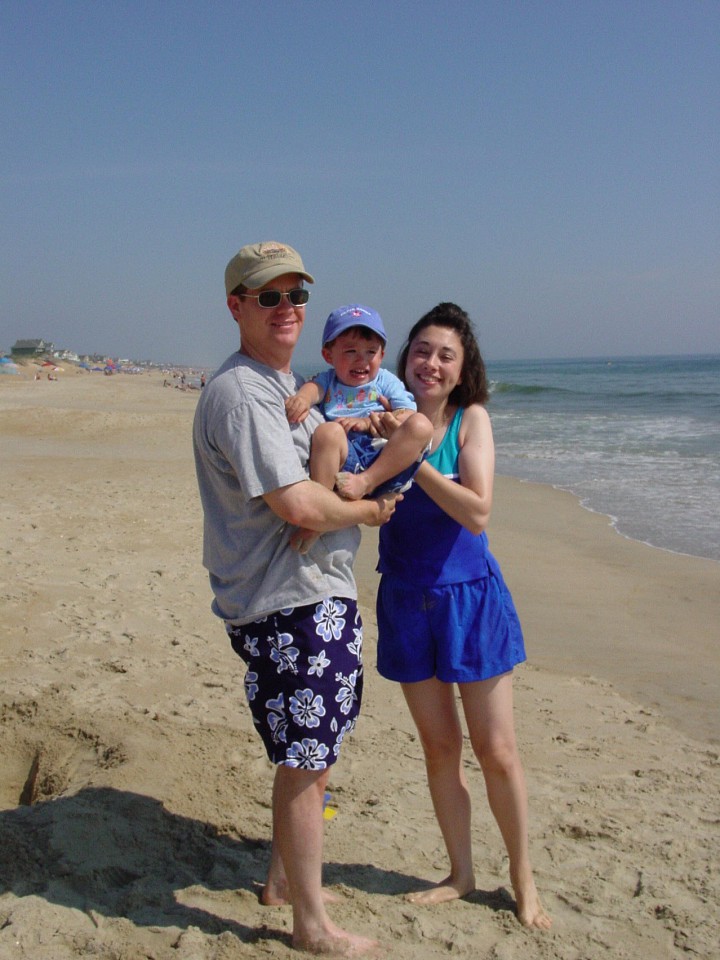
Tonight's picture was taken in July of 2004. This was Mattie's second trip to the Outer Banks. Even on the actual beach with sand, sippy cup was in tow. Sippy came with us everywhere and in all sorts of weather. Since Mattie LOVED only drinking milk, that meant that I had a cooler with me at all times. Look at Mattie's facial expression in this photo!!! Doesn't it paint quite a picture?! 


Quote of the day: Appreciate again and again, freshly and naively,
the basic goods of life, with awe, pleasure, wonder and even ecstasy,
however stale these experiences may have become to others. ~ Abraham Maslow


Our goal today was to have a more relaxing day on the island, rather than jump in a car and spend time commuting. We rented bicycles for the week. Even that was easy on Kiawah Island. You can pre-arrange a bicycle rental before you get on the island. They will drop off bikes at your condo, house, or hotel and they will pick them up at the end of the week. There is no labor or logistics to worry about. They supply you with helmets and a lock to secure your bicycles when they are not in use. So we set out to ride on the beach today. I have never rode a bicycle on the beach mainly because most beaches are not conducive to riding. Which is what makes South Carolina so unique. Very long stretches of hard packed sand, perfect for riding. 

A selfie of us sitting on our bicycles with the Sanctuary Hotel in the distance. We are staying in a condo right next to this hotel. 
The beach is filled with pelicans. They fly over us at all hours of the morning and afternoon. 
Do you get a feeling for just how expansive the beach is??? Also notice no crowds. There are people around us, but because the beach is huge, you never feel crowded. There is no loud music playing, no garbage, and no rowdiness. It is an absolutely peaceful and beautiful area and I suspect those who come here are seeking the same things as us. 
I am not sure our intention was to ride 13 miles today. But we did it. I can safely say that riding against the wind is VERY challenging. Even though the sand is flat, it almost feels like you are peddling up hill when you are riding into the wind. 

However, I was not sure what to look at first while on the beach. The water, the sand, the bird traffic or the houses. 
We looked up housing prices here and on average a house this sizei
It is not just one house but try a whole row of them that goes on for miles. If one has the money, I can see why people retire to this community. In a way it is a bit like Disneyland. Too good to be believed. The island has its own services like fire and police, it has its own grocery store (by Harris Teeter), its own shopping and lots of good restaurants. I haven't met one surly person yet. Everyone is lovely. 
This is our view while bicycle riding!
Not sure what you are seeing here? Try our National bird... the eagle. This fellow was hanging out in the tidal flats looking for prey. I tried to get as close as possible without spooking him. 
Do you see the hole in the sand next to my bicycle? Well what came out of that hole was a large whelk shell. Intact no less. We brought it back to the condo and you will see a photo of it below. 
We rode out to the eastern most point of Kiawah Island. At this tip is Little Bear Island, part of the natural conservancy. Unlike in the Outer Banks, here we have seen VERY few shore birds along the water's edge. However, we found where they all are... at Little Bear Island.  
Miles and miles of sand for as far as the eye can see. 
Thirteen miles is a long stretch to ride. So periodic breaks were needed. Unlike our city life, people around us here are more trusting and respectful. So leaving your bicycles parked in one location is no problem. 

Keep in mind that you need a permit to get onto Kiawah Island. There are guard gates all around the island, so unless you are staying here, you aren't visiting. 
Some of the houses are gigantic. Several people stopped along the beach today to admire these two. 
So here is what we bicycle rode. Starting from the round blue dot on the left, to Peter's thumb on the right, and then back to the blue dot. 


Given the incredible work out we had, we had to regroup when we got back to the condo. Thankfully we brought water with us, but air conditioning was necessary, as it was in the 80's with over 80% humidity. So it was hot. 

We decided to have a late lunch at Cherrywood BBQ. The restaurant is located within a golf course on the island. The food was wonderful and I figured we couldn't be in South Carolina without trying authentic BBQ.

Peter had a combination of BBQ chicken and ribs.
I had pulled pork with an amazing cucumber salad. Not to mention that homemade corn bread is served with these meals!
This is what we were looking out at from the restaurant. This place just seems too good to be true. Just beautiful. 

At the end of the day, this is what my shell collection looks like. Not unlike shore birds, finding shells is also mission impossible. However, we were very successful at Little Bear Island. You can see the large whelk shell on the left that Peter pulled out of the sand. Also finding sand dollars on this beach is very common! 

June 12, 2018

Tuesday, June 12, 2018

Tuesday, June 12, 2018 -- Mattie died 456 weeks ago today.

Tonight's picture was taken in July of 2004. Mattie had become acclimated to the beach by this second visit to the Outer Banks. At that point, he liked playing and building in the sand, certainly much more than being in the water. In fact, I remember Mattie's sand toys very well. I stored them in a netted bag and literally that bag of toys came with us to California, Florida, and North Carolina.  


Quote of the day: Life is a mirror and will reflect back to the thinker what he thinks into it. Ernest Holmes


Today we drove to Charleston, which is about 40 minutes from where we are staying in Kiawah Island. We toured the Nathaniel Russell house in the heart of the town. Nathaniel Russell came from a wealthy family in Connecticut, that made its money as merchants. The family sent Nathaniel down to South Carolina to expand their business, especially since the South was most profitable as it had free labor (slavery). In Southern standards however, Nathaniel Russell was "new" money, and wasn't part of the established elite. Elite which made its money through "planting." Basically owning land and plantations. 

Believe it or not, Nathaniel Russell married for the first time at the age of 50, and moved into this home with his wife, when he was in his 70s. His wife, Sarah, was 14 years younger than him and wealthy in her own right. In fact, before she married Nathaniel Russell, he had to sign what we would deem a pre-nuptial agreement. 


This is a 6,000 square foot home and the exterior is impressive. The three windows on the second-floor are emphasized by their floor length, ornamented with white marble lintels and are set in recessed red-brick arches with white keystones, tied together with a narrow white string course that runs around the entire perimeter of the house. Also featured is a light wrought-iron balcony that breaks out in a semicircle before each of the second-story windows, and displays Nathaniel Russell's initials in the center (do you see the NR initials, scrolled on the middle balcony wrought iron balcony).


Surrounding the home were lush English type gardens. 
The house features three main rooms per floor each of different geometric designs: a front rectangular room, a center oval room, and a square room in the rear. The rectangular entrance hall had a black and white diamond patterned floor cloth edged with a leaf motif. The entrance hall was like a waiting room for people who wanted to do business with Nathaniel Russell. Invited guests never waited in this room. 

Separating the public entrance hall at the front of the house from the more private rooms used by the family and invited guests were these incredible doors. The doors were made out of pine, not mahogany as the painted on design would suggest. In fact, these faux-grained double doors were a symbol of wealth, because it would mean that he had the means to have artists use the trompe l'oeil technique to deceive the eye.
The golden walled stair hall showcases the most important architectural feature of the house.... the cantilevered spiral staircase, that ascends to the third floor. The asymmetrical hall is illuminated by a Palladian window, and further ornamented with trompe-l'œil painting resembling a plaster cornice. The staircase looks like a feat of science actually. 
Get the feeling for this incredible three story staircase?


Looking all the way up the staircase, you see a medallion on the ceiling. Again this is an optical illusion, since this is a piece of trompe l'oeil. It is not a three dimensional structure. 


Off the central stair hall is the oval dining room, with turquoise walls that appear painted, but instead are small squares of unpatterned wallpaper bordered with interlocking rings, in red and gold, above cypress wainscoting painted white. The pine floors and the wood interior shutters are original.

The dining room featured paintings of members of the family. This being Nathaniel Russell. 


At the rear of the house was a square palor. It was used only by family. Guests were not invited inside. Take a look at what the family ate off of everyday... Canton china. In fact, Nathaniel Russell was the largest importer of Canton china to the USA.

This is second floor landing! It was very impressive with that stair case and palladin window. 


The second-floor oval drawing room is the most highly decorated room in the house and is where the women of the house retired to after dinner.   

Papered in apricot, it featured elaborate plaster moldings covered with 24-karat gold leaf
Blocks at the base of the door frames were painted to resemble lapis lazuli.
The ornamentation of the fireplaces' mantle and cornices are among the most detailed in the city. Nathaniel Russell wanted to highlight the art and culture of Europe as was reflected in his clock, mantle, and china. Having these possessions illustrated his worldliness and his desire to introduce these things to South Carolina. 


As our docent said today.... every fine English home had to have a piece of Wedgwood in it! So in Nathaniel Russell's case, he had Wedgwood candle holders. 


After the house tour, we walked around the main area of Charleston. Which was no easy feat, since it ranged from drizzling to pouring. 

However, we were determined to see single houses. Peter and I have been watching the TV show, This Old House, and recently they have been renovating two houses in Charleston. Both houses are single houses, which is how we learned about this architectural style. Turns out there are single houses all of Charleston. As my photos will show you. 

A single house has its narrow side along the street and a longer side running perpendicular to the street.  A front door on the long side of the house opens onto a short central hall and staircase. There is one room on each side of the hall, that is, one toward the street and one toward the rear of the house. The result is a building which is only one room wide when viewed from the street, giving the form its popular name. Each floor contains two rooms, and the floorplan is reproduced on each upper floor.

Another single house. Notice the two- and three-story porches, known locally as piazzas. The piazzas always appear on the side of the house with the front door in order to take advantage of local winds.
 and another!
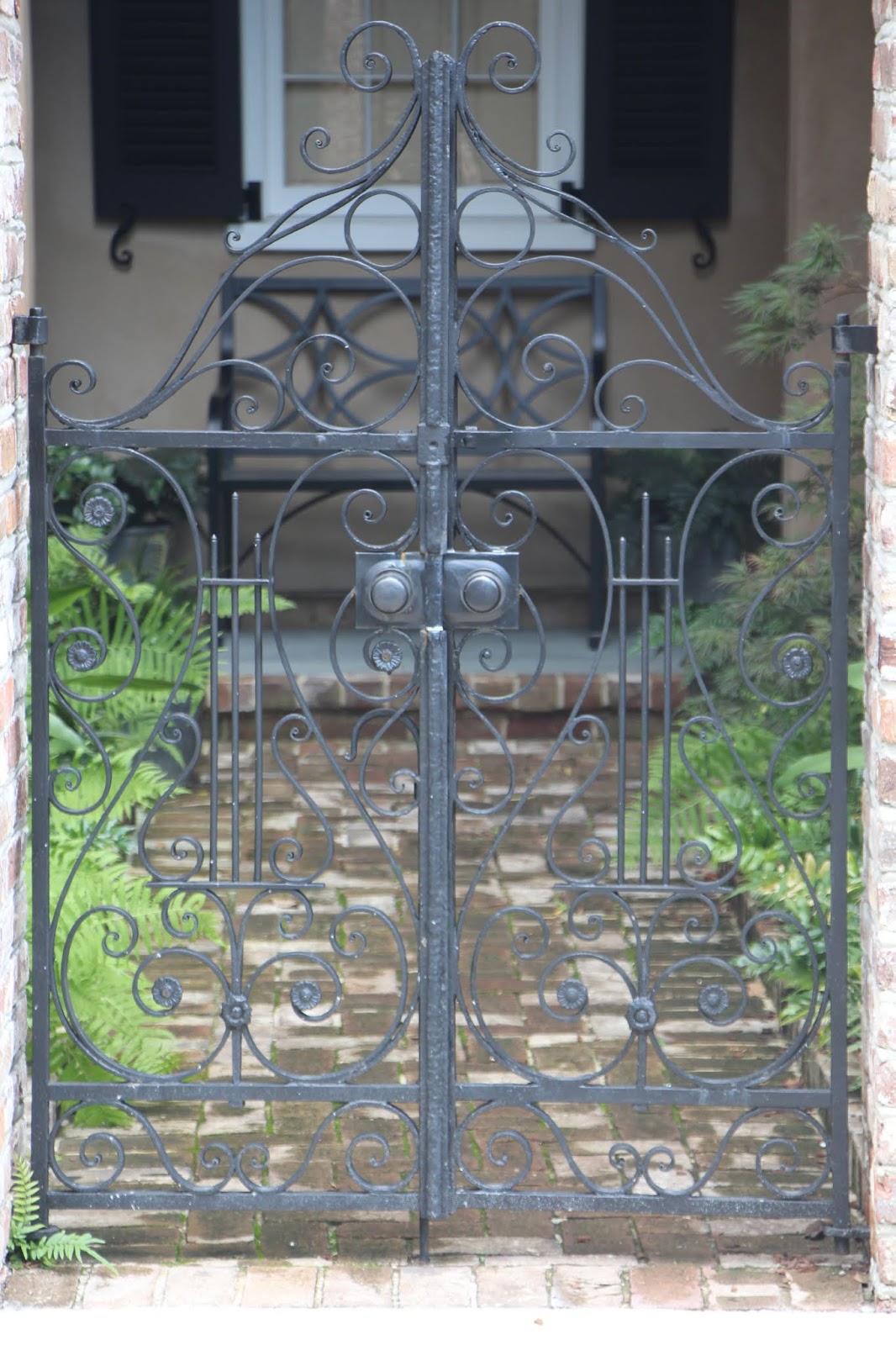
Any stroll through Charleston will bring you in close encounter with another of Charleston’s treasures -- decorative ironwork. From gates to rails to windows to balconies, Charleston’s love affair with the beauty of finely crafted wrought iron is evident. 

Charleston’s affinity for decorative wrought iron came about early in the history of the city. In 1772, a wrought iron communion rail was imported from England and installed in St. Michael’s Episcopal Church. Blacksmiths, who had made a career of providing nails, horseshoes, and wagon wheels to the growing city, now began to expand their craft to include patterns and scrollwork. The earliest designs were taken from British pattern books, but it didn’t take long for the ironwork of Charleston to develop its own style. 
When you look through the gates of homes, you always see greenery and gardens!

Unfortunately, much of the earliest ironwork did not survive the multitude of of fires and natural disasters that plagued those early inhabitants. 
The streets are lined with all sorts of plantings. Beautiful, beautiful flower boxes everywhere. 
This gate reminded me of the sun. 
This is the most photographed block in Charleston, on East Bay Street. This is Rainbow Row.

Merchants constructed commercial buildings with stores on the ground floor and living quarters above. Most of the buildings had no interior access between the first and second floors; exterior stairs were located in the yards behind the houses. In 1778, a fire destroyed much of the neighborhood, and only 13 houses were spared.


After the Civil War, this area of Charleston turned into near slum conditions. In the 1920s, Susan Pringle Frost, the founder of the Preservation Society of Charleston, bought six of the buildings, but she lacked the money to restore them immediately. In 1931, Dorothy Haskell Porcher Legge purchased a section of these houses and began to renovate them. She chose to paint these houses pink based on a colonial Caribbean color scheme. Other owners and future owners followed suit, creating the "rainbow" of pastel colors seen today. The coloring of the houses helped keep the houses cool inside as well as give the area its name. By 1945, most of the houses were restored.

June 11, 2018

Monday, June 11, 2018

Monday, June 11, 2018


Tonight's picture was taken in July of 2004. This was Mattie's second trip to the Outer Banks of North Carolina. As you can see, Mattie was practically jumping out of Peter's arms. Mattie did not like the sound of the ocean or being on the sand for that matter. However, by the third visit to the Outer Banks, Mattie took to it like a duck to water. By that point, he understood the sound of the waves and loved playing in the sand.


Quote of the day: Always be a first-rate version of yourself, instead of a second-rate version of somebody else. ~ Judy Garland


We had a full day of touring as we visited USS Yorktown and Fort Sumter. To get to these sites, we had to cross the Arthur Ravenel Jr. Bridge. This bridge is a cable-stayed bridge over the Cooper River in South Carolina connecting downtown Charleston to Mount Pleasant. The eight lane bridge has a main span of 1,546 feet and is the third longest cable-stayed bridge in the Western Hemisphere.
This what the Ravenel Bridge looks like in profile. What you can't appreciate from this photo is just how tall this bridge is.... it needs height as cargo ships pass under this bridge often. 
This is the USS Yorktown, CV (Commissioned Vessel) 10. Now a National Historic Landmark. 

The USS YORKTOWN (CV-10) was the tenth aircraft carrier to serve in the United States Navy. Under construction as Bon Homme Richard, this new Essex-class carrier was renamed in honor of YORKTOWN (CV-5) sunk at the epic Battle of Midway (June 1942). Built in an amazing 16 ½ months at Newport News, Virginia, YORKTOWN was commissioned on April 15, 1943. World War II’s famous “Fighting Lady” would participate significantly in the Pacific offensive that began in late 1943 and ended with the defeat of Japan in 1945. YORKTOWN received the Presidential Unit Citation and earned 11 battle stars for service in World War II.

In the 1950s, YORKTOWN was modernized to operate jet aircraft as an attack carrier (CVA). In 1957, she was re-designated an anti-submarine aircraft carrier (CVS), and would later earn 5 battle stars for service off Vietnam (1965-68). The ship also recovered the Apollo 8 astronauts and capsule (December 1968). YORKTOWN was decommissioned in 1970 and placed in reserve.

This was the highlight of my trip. Peter and I met these three Vietnam Veterans. They served together and now live in different parts of the Country. However, they remain in touch and even their wives are friends. In fact, they said they will be having a 50th reunion in Dallas, TX this year and they all plan on going. 

From left to right are: Arthur, Dan, and Dave. Each of them was awarded a Purple Heart for being wounded in the line of duty. 

Peter with Arthur, Dan, and Dave. They were the nicest men and were happy we asked about their lives and were humbled that we thanked them for their service. 


This is the walkway up to the USS Yorktown. I have to say the entire journey is a patriotic experience. In fact, the Ship is located on what now is called Patriot Point and there are American Flags flying everywhere. 
Some Ship facts:
]
Displacement: 27,000+ tons (1943) 30,000+ tons (1956)

Length: 872 feet (1943) 888 feet (1956)

Speed: 30+ knots

Range: 14,000 nautical miles at 13 knots
We were able to capture these wonderful views of the Ship, because we took a cruise from the USS Yorktown dock to Fort Sumter. During this 15 minute journey across the Cooper River, we had the ideal view of Yorktown.


The Spirit of Charleston that took us to Fort Sumter. 
The bow of the USS Yorktown.
A close up of the USS Yorktown, with its banner that reads... I Pledge Allegiance!


To be honest, I can't imagine life aboard an aircraft carrier. We saw it under ideal conditions... it wasn't moving and there were no missions being deployed. Yet everything was confined, dark, and not well ventilated. I snapped this photo because this is what the stairs up and down looked like. They are very steep and narrow. More like a ladder than stairs. I can't imagine anyone quickly moving up and down these things, much less multiple people using them at one time. 
Believe it or not, this was the bathroom. Communal sinks, toilets, and shower stalls. There were no doors or curtains in the showers. 
Where the crew ate, all 3,500 of them!
Sinks!!!
Beds!! They look more like gurneys rather than beds! But rows and rows of them.  
 The kitchen!
The hallway to medical care. The USS Yorktown was like a floating city. It had everything and was self contained. 
This was the operating room aboard the Yorktown. 
This was sick bay, for when crew needed to be contained to prevent contamination. The photo may not do this justice. But it is confined and each patient has little to no personal space. 
There was even dental care aboard!
 A chapel
A jail for those who did not follow the law and order of the ship. 


The flight room, where pilots received their orders. 
The flight deck. 


The Hangar of the air craft carrier. This is actually the level we were able to enter onto the Yorktown. Picture a large warehouse filled with planes and that is what it looked like. 
The flight deck. 
Aother view of the flight deck.


After touring the USS Yorktown, we boarded a boat that took us across the river to Fort Sumter. We have never seen a Fort that was completely surrounded by water and not connected to land. 
The white marble entrance sign. 
On April 12, 1861, the Confederate forces bombarded Fort Sumter and the Civil War began. Major Anderson represented the Union at the Fort. However, by April 14th, the Union surrendered and the Fort fell to Confederate hands. Fort Sumter was the center of conflict as Union forces struggled to regain control over the Fort and Charleston Harbor. Fort Sumter was subjected to a Union blockade, attacks by ironcad war ships, and a 22 month siege. 

We received a short orientation from one of the park rangers. She did an excellent job explaining the history of the Fort. As the Fort went back and forth in the hands of the Union and Confederate. The issue of slaves and their freedom was what divided our Country, with 7 states disassociating from our United States. 

What caught all of our attention was the beautiful way the park ranger described the pride that the Union and Confederate troops had when their respectful flags flew over the Fort. When the stars and stripes flag was flying, the Union troops felt proud that they reclaimed the Fort, and at the same time the Confederate troops were demoralized to see their flag removed. The ranger had us focus upon what the American flag means to us, and in essence how these conflicting troops must have felt when their flag claimed the Fort. 

The fort had over 7 million pounds of ammunition fired at it, and in some cases the munitions hit the fort's walls and were left in place. Here Peter is pointing to one of the shells that remained lodged within the fort's wall.
 This is a shot from atop the middle part of the fort. You can see what remains of the original walls. On the left was the back section facing the land that was pounded with shells until it was almost reduced to rubble. In the background you can see the outline of the city of Charleston.


This is a vertical shot that Peter took of the flag pole that sits on the fort. The man carved into its base was Captain Robert Anderson, who was the Union commander that held the fort for 34 hours when Confederate troops shelled the island. Peter took this shot while laying on his back and pointing the camera upwards towards the sky. It was quite a sight..
This is the actual flag that was flown during the 34 hour long siege by the Confederate troops. Ironically, the day before the April 12th, 1861 shelling began, the actual American Flag flying above Fort Sumter, had been torn to shreds during a wicked storm. The troops took down the torn American Flag and instead hoisted a weather warning flag that had only 33 stars. After the Union troops surrendered the Fort, they were allowed to take down and remove this flag, which has been preserved for all of history.

This is the flag that the Confederate troops hoisted once they took control of the Fort. This is a South Carolina Militia Flag with the the palm tree and a red start representing the lone dissenting state of South Carolina that was the first state to succeed from the Union in 1861. South Carolina was followed by 6 other states in total that succeeded from the Union, which were Louisiana, Mississippi, Alabama, Georgia, Florida and Texas.