A Remembrance Video of Mattie

Thank you for keeping Mattie's memory alive!

Dear Mattie Blog Readers,

It means a great deal to me that you take the time to write and to share your thoughts, feelings, and reflections on Mattie's battle and death. Your messages are very meaningful and help support me through very challenging times. I am forever grateful. As my readers know, I promised to write the blog for a year after Mattie's death, which would mean that I could technically have stopped writing on September 9, 2010. However, like my journey with grief there is so much that still needs to be processed and fortunately I have a willing support network still committed to reading. Therefore, the blog continues on. If I should find the need to stop writing, I assure you I will give you advanced notice. In the mean time, thank you for reading, thank you for having the courage to share this journey with me, and most importantly thank you for keeping Mattie's memory alive.


As Mattie would say, Ooga Booga (meaning, I LOVE YOU)! Vicki


August 4, 2020

Tuesday, August 4, 2020

Tuesday, August 4, 2020 -- Mattie died 566 weeks ago today. 

Tonight's picture was taken in August of 2008. Mattie was in his first month of treatment. Our second home was the hospital, and in fact, that year, we spent more time living in the hospital than at home. That weekend, Peter's family came to visit Mattie in the hospital. Keep in mind that Mattie's hospital room was located on the fifth floor of the building in the background. Yet we were all outside! That was because Mattie's nurse, Miki, understood how important it was for Mattie to interact with his cousins in a more normal setting. So she allowed us to go to the hospital rose garden (located on the second floor of the hospital). As you can see Miki came down from the fifth floor unit to periodically check on Mattie and his IV lines. Mattie's nurses really got it right from the beginning..... that childhood cancer is NOT just about the medicine. 


Quote of the day: Today's coronavirus update from Johns Hopkins
  • number of people diagnosed with the virus: 4,765,170
  • number of people who died from the virus: 156,668


I did not sleep well last night. Most likely because I was stressed out about having to get up at 4am and flying across the Country today. When I arrived at Reagan National, this is what I saw. A ghost town!
While waiting for my flight, Peter sent me some photos of Sunny and Indie. Both of them were besides themselves today, because they were concerned that I was up so early! Don't you just love Sunny's expression?
Meanwhile, now that my shoes are gone, look who took over my shoe tray? Miss Indie!
I got lucky today, I had no one sitting next to me. It was delightful and made me feel less anxious which was good since it was a bumpy flight. The airline was very vigilant today about face mask wearing. In fact, if you did not comply you were told that you would be prevented from going on future flights. 
It was pouring in DC! I left grayness. 
We flew in horrible clouds for 45 minutes to an hour. With intense shaking and turbulence. The kind where you thought it was never going to end. 
Then all of a sudden, we left clouds and there was beautiful blue skies!
The grand canyon. 
Clouds and smog over Los Angeles. 
Left grayness, and landed into it! But fortunately in LA, this is only in the morning and then the sun comes out. 

The airport was like a ghost town and there was little to no traffic on the freeways. Which is unheard of. I got to my parent's home around 10am. It was a full day of travel. But I hit the ground running doing chores and got a lot accomplished. 

I am trying to assess how my dad is doing compared to when I left him a month ago. I would say his cognitive ability has improved significantly since June, but his physical issues remain. It is my hope that my presence here can help jump start a more significant improvement. 

August 3, 2020

Monday, August 3, 2020

Monday, August 3, 2020

Tonight's picture was taken in August of 2009. Mattie was driving "Speedy Red." A ride-on vehicle that we got for him. It was in a way his last request. Mattie had always wanted this toy, as our neighbor's children had one. When Mattie was well, we refused to get him this very expensive toy. We figured that it would be a very short lived fancy and therefore we were not going to make this investment. However, when we knew Mattie was dying, our attitude changed greatly. I am not sure what the learning lesson is here! In any case, Mattie loved Speedy Red, and he was a natural driver. He just understood the mechanics of driving without much instruction. Nonetheless, I was his passenger, as Mattie was tethered to oxygen and a pain pump and my constant goal as his mom was to make sure he was safe. 

Quote of the day: Today's coronavirus update from Johns Hopkins
  • number of people diagnosed with the virus: 4,696,573
  • number of people who died from the virus: 155,165

The highlight of my Monday was walking with Sunny and Peter on Roosevelt Island. I leave for Los Angeles tomorrow, and I certainly will miss my three some at home. 
I am not sure who was watching who! Sunny was glued to this squirrel! The squirrel was interested in us, but he wasn't about to drop this nut and leave! He held his ground! But what a racket he was making while chomping on this nut. 

Frankly in times of chaos, like living in constant lock down mode, we turn to nature. We find it freeing and peaceful, and walking on the Island is our escape from the reality of the world for an hour. 
Toward the end of our walk, we hear a loud thump! I stopped in my tracks to locate the sound! I found this Downy woodpecker not far from where I was standing. He was a brazen fellow, as my presence did not seem to scare him in the least. 
Meanwhile, Miss Indie is branching out! She is finding all the comfortable places to rest. Today she was on Mattie's bed. Sometimes I even find her on Sunny's bed! The irony is despite Sunny's size, if Indie is sitting on something, Sunny doesn't move her. He waits his turn! Indie rules the roost here.

August 2, 2020

Sunday, August 2, 2020

Sunday, August 2, 2020

Tonight's picture was taken in August of 2009. Mattie was in the hospital and struggling. Managing intense pain and gasping for air to breathe. Not to mention that his abdomen kept filling with fluid, as his cancer was taking over. On Mattie's dry erase board in his room, we posted a few things to brighten his day. One was a drawing from his good buddy Kazu and the other drawing was from Holly (one of Jocelyn's sisters; Jocelyn was Mattie's cancer buddy and mentor). The third posting was a photo of the Lego master builders who Mattie met and worked with at the Lego store on August 9, 2009. 


Quote of the day: Today's coronavirus update from Johns Hopkins
  • number of people diagnosed with the virus: 4,657,207
  • number of people who died from the virus: 154,779

I have been highlighting Sunny on the blog and I did not want to leave out Miss Indie. We have placed one of Indie's perches by our bedroom window. We thought she might like being up higher off the ground and with a good view (as there is a big oak tree outside the window which gets a lot of bird traffic). After several weeks of trying to introduce her to the new space, she is finally going there on her own. A real cat! 


I was listening to the radio today and heard the term "COVID fatigue." It caught my attention because I can absolutely relate to this new coined term. So I decided to look it up on the internet. COVID fatigue has been applied to both survivors of the virus as well as to people (unaffected by the virus) living their everyday lives in lock down. For survivors, apparently many of them face chronic fatigue for weeks and monthly after diagnosis. Symptoms such as profound exhaustion, trouble thinking or remembering, muscle pain, headaches, and more. Frankly this is not surprising to me as there are many diseases out there (cancer being one of them) that trigger these same long term affects on the patient and family members. 

For the purposes of this posting, I am focusing on COVID fatigue experienced by many of us, who were not diagnosed with the virus. The article is entitled, COVID fatigue is hitting hard. Fighting it is hard, too, says UC Davis Health psychologist
(https://health.ucdavis.edu/health-news/newsroom/covid-fatigue-is-hitting-hard-fighting-it-is-hard-too-says-uc-davis-health-psychologist/2020/07). The author of the article talks about a collective fatigue that we all feel about having to remain at home, wear masks, and be socially distant from others. However, at the same time she explains that this fatigue causes some people to rebel and be careless because they no longer want to abide by what our local officials are mandating. 

For the most part I understood the intentions of this psychologist, until in big bold letters I saw..... ABNORMAL IS THE NEW NORMAL. Really? I hated the term new normal when Mattie was diagnosed with cancer, and I equally despise it now. Nothing abnormal or forced upon us should ever be accepted as a NEW NORMAL, period. Putting this aside, I do agree with her, that intense stress and prolonged stress can have devastating long term effects on our physical and mental health. I saw that personally with Mattie's cancer journey and I am observing it now in people all around me impacted by the psychosocial ramifications of a five month lock down. 

The article continues on by discussing the stages of disaster stress. Meaning stages people go through when faced with a disaster. The first being that communities come together to support each other. We may see acts of kindness from those around us. I get what she is reporting, but I can safely say I did not experience this where we live, in the middle of the city.  After this kindness stage, comes the disillusionment phase. Which is where we are now as a society, in which we have lost our optimism and start to have negative or angry reactions. Specifically the article points out that:
  1. “Many people are exhausted by it all.” 
  2. “Some are saying they don’t care if they get COVID-19. They’d rather risk getting sick than stay home or be careful."
  3. "Others have simply stopped listening to health leaders and science.”

Any and all reactions to prolonged stress are understandable to me. Yet how do we cope with our feelings and reactions while still maintaining our own safety and the safety of those around us? This is the BIG question and I am sure the answer is different for all of us. But two things I know are mentioned in the article and that I have found helpful and these are: 1) walking and 2) talking. Things that Peter and I do daily. Sunny is truly our mental health puppy! He gets us out, exploring, engaging, and talking regardless of the weather. However, I do not discount gratitude either, which was also mentioned in the article. Having seen Mattie get diagnosed with cancer and die, and watching my dad deal with his own health issues, I have learned that if you have a healthy day in your life, it is a gift. I do not take it for granted and though I would be the first to tell you I HATE lock down and wearing a mask, I am aware of what I do have...... my health and the safety of our home. 

August 1, 2020

Saturday, August 1, 2020

Saturday, August 1, 2020

Tonight's picture was taken on August 18, 2009. Mattie was home temporarily and was playing with his remote controlled boats in his kiddie pool. That pool was once a place Mattie would go into and play, but given how Mattie was feeling and the fact that his broviac catheter wasn't allowed to get wet, he no longer went in the water. So he sat in a chair, wore his Captain Mattie hat and played with his boats. Mattie loved boats and wanted to save his pennies to buy a real boat one day. That was his wish. It is hard to believe that Mattie died 22 days after this photo was taken. 


Quote of the day: Today's coronavirus update from Johns Hopkins
  • number of people diagnosed with the virus: 4,603,204
  • number of people who died from the virus: 153,986

Thanks to Sunny, we have outings outside of our home on a daily basis. Given the intense heat, we like to walk Sunny at local parks. It assures us wide open green spaces, peacefulness, and an adventure for Sunny. Given Sunny's age and that he is recovering from knee surgery, we try not to push him. His mind is willing, but the body can't always keep up. Nonetheless, he gets water breaks along the way and time to take in his surroundings. 
Turkey Run Park is a beautiful place! There are trails to walk in the woods and then there is also this wonderful pavement! We like taking Sunny on both trails and pavement. It breaks up the walk. 
Through the trees, you are looking at the Potomac River. It is a wonderful escape from the city and living in constant lock down. 

July 31, 2020

Friday, July 31, 2020

Friday, July 31, 2020

Tonight's picture was taken in July of 2009, during Brandon's 19th birthday party in the clinic. Mattie and Brandon were diagnosed with cancer around the same time in 2008. Mattie and Brandon, despite their age difference of 12 years, got along splendidly. Mattie called Brandon his "best buddy." That day in clinic, Mattie, Brandon, and Jocelyn (another good friend and mentor to Mattie) celebrated! They played at the art table together and also enjoyed ice cream and cake. It is hard to believe that both Mattie and Jocelyn died from osteosarcoma. 

Quote of the day: Today's coronavirus update from Johns Hopkins.
  • number of people diagnosed with the virus: 4,541,016
  • number of people who died from the virus: 152,922

In Washington, DC, and most areas of the country, we have been dealing with the lock downs associated with COVID-19 since March. That is five months, with still no end in sight. Funny when I think back to the 14 days of shut down originally promised to us in March, I thought that was bad. It sounded bad at the time, but thankfully most of us couldn't fathom this extending passed two weeks. I came across an article today entitled, There are no hours or days in Coronatime (https://www.wired.com/story/coronavirus-time-warp-what-day-is-it/). The title alone caught my attention, because it is true! It is hard to keep track of one day from the next! As each day looks just like the day before it. 

Time, according to Aristotle, is the measure of change. It depends on what is shifting, reshaping, and what remains the same. The article highlights when you are stuck at home day after day, “the brain likes novelty.” “It squirts dopamine every time there’s something novel that’s happening, and dopamine helps set the initiation of the timing of these events.” In this model, the brain clocks those novel experiences, stashes them away as memories, and then recounts them later to estimate the passage of time. No novelty, no dopamine—and then “perceptual systems don’t bother encoding stuff.” 

I agree with the author of this article..... "No one knows when this will be over, or what the world will look like on the other side. Our experience of time isn’t just different because we are fearful or bored, cooped up or overworked. It has changed because we don’t yet know what to measure it against."

Sunny on our daily afternoon walk!
Another deer sighting on Roosevelt Island!
This deer looks like Bambi, no?
As we were coming home, Peter saw something big perched on a window sill. I couldn't believe this was real, but indeed it was a Cooper's Hawk sitting up top having a meal! 

July 30, 2020

Thursday, July 30, 2020

Thursday, July 30, 2020

Tonight's picture was taken in July of 2009. Mattie was in the outpatient clinic sitting at the art table. As you can see it was a busy place! That day, Mattie and his friend, Maya (the only same aged friend Mattie made in clinic), built a stage for a play out of boxes. They worked on it for a while and then proceeded to act out a play  about space aliens. You may not be able to feel the energy through the photo, but there were many children all around us and they were all engaged when the play unfolded. 


Quote of the day
  • number of people diagnosed with the virus: 4,475,979
  • number of people who died from the virus: 151,570


We went for a walk today on Roosevelt Island. Check out what crossed our path! The deer are all over on the Island and because there is less people traffic due to COVID, we are really seeing nature come alive this summer. Needless to say, Sunny was VERY intrigued. 
I think deer are quite beautiful and the ones on the island are used to people. After all, we are visiting their home. The deer are frightened of Sunny and keep a close eye on him. 
A close up of the female deer. 
This is a young buck! Can you see his budding antlers?
Have you ever come close up to a spider web? This one was quite extraordinary. Mattie would have appreciated this. 

Did you know.......
Spiders produce silk from their spinneret glands located at the tip of their abdomen. Each gland produces a thread for a special purpose – for example a trailed safety line, sticky silk for trapping prey or fine silk for wrapping it. Spiders use different gland types to produce different silks, and some spiders are capable of producing up to eight different silks during their lifetime. Most spiders have three pairs of spinnerets, each having its own function – there are also spiders with just one pair and others with as many as four pairs.

Webs allow a spider to catch prey without having to expend energy by running it down. Thus it is an efficient method of gathering food. However, constructing the web is in itself an energetically costly process because of the large amount of protein required, in the form of silk. In addition, after a time the silk will lose its stickiness and thus become inefficient at capturing prey. It is common for spiders to eat their own web daily to recoup some of the energy used in spinning. The silk proteins are thus recycled.

July 29, 2020

Wednesday, July 29, 2020

Wednesday, July 29, 2020

Tonight's picture was taken in July of 2009. As you can see, our living room floor was BUSY! Car tracks, cars, Legos...... you name it, it was in our living room. That weekend, Peter and Mattie built the Lego Taj Mahal together. It truly was labor intensive, but a work of art. The Taj sat in our living room for ten years. At which point, I dismantled most of it, except for its center tower. That remains with us, as I feel it is a symbolic piece of our cancer journey together!


Quote of the day: Today's coronavirus update from Johns Hopkins

  • number of people diagnosed with the virus: 4,398,898
  • number of people who died from the virus: 150,062


Peter and I have both commented since March that we are dreaming more! As research seems to indicate, we aren't necessarily dreaming more, but we are remembering our dreams more! Why? Our sleep cycles maybe off. Since many of us are working from home, we are sleeping later than usual. The brain normally moves through the REM (the last and deepest part of the sleep cycle) sleep cycle several times a night -- about once every hour and a half. So the longer you sleep, the more dreams you can have. Or we maybe tossing and turning and waking up frequently throughout the night. Thereby, coming into conscious from a dream, which enables us to remember our dream more vividly. 

It is reported that 87% of Americans have had unusual dreams since the pandemic began. I attached a link to an article below. As researchers are conducting a sleep survey and are asking for people to share their dreams. People are having nightmare about getting sick, about feeling helpless, getting attacked, and so forth. The fears we face in quarantine, are popping up at night in our dreams. Our brains are trying to face our anxieties that naturally arise under a crisis, and I would say being locked down for months, forced to socially distance, and wear a mask qualifies as a very big and indefinite crisis.  

The article goes on to discuss the different dreams that non-health care workers have compared to first responders. Noting that doctors, nurses, and other medical personnel are more likely to have dreams about saving someone’s life, and not having any control over what’s happening. When reading this my reaction was, yes, I can understand this. Months and perhaps the first year or so after Mattie died, my dreams were more like the kind of nightmares a health care professional would have. I was reliving Mattie dying in my dreams, but dying in different ways (drowning, falling off a cliff, etc). Either case the end was the same.... Mattie was dead and I couldn't prevent it!

Anycase, if you are like us, and find yourself remembering your dreams since COVID began, you might find this article of interest. 

COVID and Sleep: Sweet Dreams Aren’t Made of This:

https://www.webmd.com/lung/news/20200527/covid-and-sleep-sweet-dreams-arent-made-of-this

July 28, 2020

Tuesday, July 28, 2020

Tuesday, July 28, 2020 -- Mattie died 565 weeks ago today.

Tonight's picture was taken on July 27, 2008. Only four days after Mattie's cancer diagnosis. I can still remember the feelings we had during that moment in time. It was before the news really sunk in and a plan was developed. Back then it felt like a switch turned on inside of us and we couldn't sleep, eat, or truly sit still. A total level of agitation, anxiety, and fear rolled into one. Yet we tried the best we could to keep Mattie engaged and doing the things he liked. Such as sandbox time on our deck!


Quote of the day: Today's coronavirus update from Johns Hopkins

  • number of people diagnosed with the virus: 4,309,230
  • number of people who died from the virus: 148,298


Mattie Miracle is proud to announce that the Psychosocial Standards of Care officially have a published toolkit. The toolkit is comprised of the Matrix and Guidelines. 

This toolkit is necessary, because the Standards themselves are voluminous and though scientifically rigorous in their creation, it has been difficult for clinicians to implement them without evidence based guidance. This is where the toolkit comes in. Mattie Miracle has provided on going support for this work and we also paid for the toolkit's publication (specifically providing the public open access to the publication indefinitely). 

I welcome you to check out the publication and don't forget to look at the supporting information link at the bottom of the article to access the Matrix and Guidelines. 

https://www.onlinelibrary.wiley.com/doi/10.1002/pbc.28586

The Matrix, is an assessment tool treatment sites can use to score how well their program meets each of the 15 psychosocial standards of care. The score is provided on a five point Likert scale. The higher a score on the Matrix, the more comprehensive a program is at meeting a Standard of Care. 
The Guidelines are a companion tool to the Matrix. Guidelines provide specific guidance on “how to” improve the implementation of each Standard and the center's level/quality of care.


Just like the development of the Standards (2012-2015), which was a three year process, the creation of the toolkit was a four year endeavor (2016-2020). Truly this type of historic evidence based research is a labor of love and we are so grateful to the core research team for their tireless efforts, commitment, and passion to see the Standards in action. The Matrix and Guidelines will enable this to be possible. Now: 

  1. treatment programs will have an easier time assessing whether their psychosocial services are in line with the Standards of Care, 
  2. the Matrix and Guidelines will help clinicians' improve the quality of psychosocial care provided to children and families, and 
  3. ultimately these tools will enable quality Standards of Care implementation research. 

July 27, 2020

Monday, July 27, 2020

Monday, July 27, 2020

Tonight's picture was taken on July 29, 2008. Mattie had undergone a bone biopsy earlier in the week and it was time for his big bandage to come off. Mattie did not like the sensation of tape being removed from his skin. In many ways, the motion to remove a bandaged triggered volatile reactions. Mattie did not want me near his arm or the bandage and so you can see him gingerly trying to remove it himself. Over time, as Mattie became more fragile and also more exhausted from chemotherapy, we took over and managed weekly bandage changing and cleaning of his broviac (the catheter in his chest that connected to a major blood vessel in the heart). Every aspect of cancer care required the impossible and the extraordinary from all three of us.  


Quote of the day: Today's coronavirus update from Johns Hopkins
  • number of people diagnosed with the virus: 4,276,856
  • number of people who died from the virus: 147,303

I received a newsletter from the Evermore Foundation today. I know the founder, as she is a bereaved mom, whose daughter died at the same hospital as Mattie. We actually served on a hospital grand round presentation together after our children died. Like me, she created a non-profit. Her non-profit is dedicated to making the world a more livable place for bereaved people and families. Where all families and professionals have access to care, programs, tools and resources to cope and adapt to loss.

The newsletter came with this link. The link took me to a document entitled, Bereavement Facts and Figures. I encourage you to check it out, because it is noteworthy! The facts that caught my attention were:

  1. The prevalence and incidence of bereavement is high due to the “multiplier effect,” meaning for every one death multiple individuals are impacted.
  2. Family survivors are now themselves at risk of poor physical health outcomes, premature death, and other adverse consequences that can alter the life course.
  3. Parents who lose a child at any age are at risk of premature death as early as age 40, with mothers dying from unnatural causes in the first three years and natural causes 10-18 years later. 
  4. Bereaved parents are more likely to suffer cardiac events, immune dysfunction, depressive symptoms, poorer well-being, less purpose in life, more health complications, marital disruption, psychiatric hospitalization, cancer incidence, and premature death as early as age 40.
  5. Parents who lose a child before age 40 are at greater risk of developing dementia when compared non-bereaved parents.

Shedding light on the bereaved and the long term consequences of grief is not only necessary but crucial to the health and well-being of our society. Grief is one of those things that truly isn't discussed or adequately addressed and supported in our world. Yet the loss of a loved one has psychological and health consequences for those left behind. Grief isn't just an issue the first year after a death, instead I have learned from personal experience that it is a lifelong journey.


"Speaking Grief" Full Length Documentary Trailer (3 minutes):


July 26, 2020

Sunday, July 26, 2020

Sunday, July 26, 2020

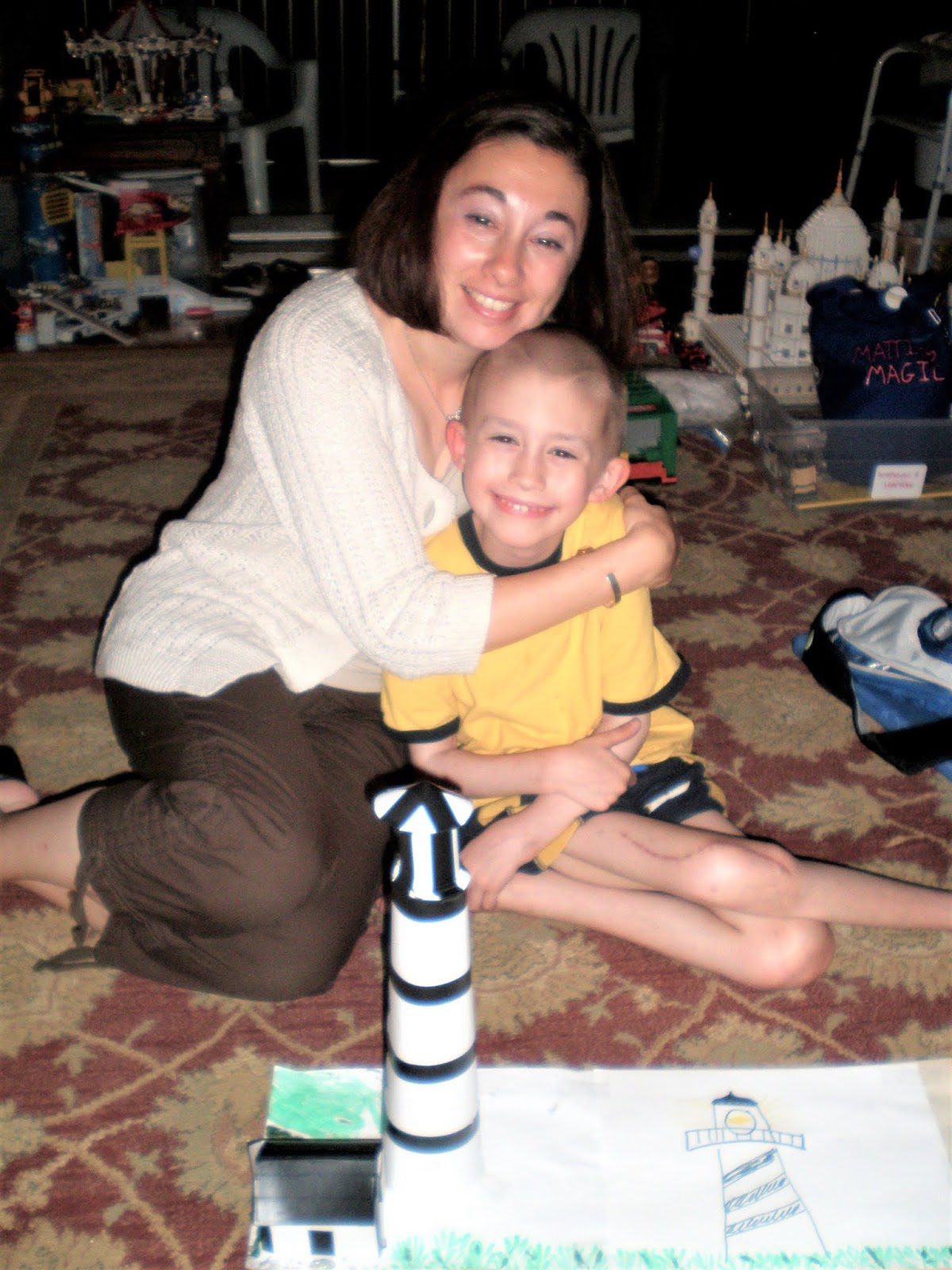
Tonight's picture was taken in July of 2009. On my birthday! Mattie, with the help of Peter's parents, created this wonderful 3-D lighthouse birthday card for me. He presented it to me and you can see he was beaming with pride. I am so glad we snapped photos of that moment in time and of Mattie's lighthouse. Mattie knew I loved lighthouses and I shared that enthusiasm with him over the years. You can also see the state of our living room while Mattie was in treatment. There were toys and things everywhere!


Quote of the day: Today's coronavirus update from Johns Hopkins

  • number of people diagnosed with the virus: 4,212,057
  • number of people who died from the virus: 146,732


I came across an article today (posted below) about the use of Google Map technology (started in 2007) to help patients with dementia remember.  I had no idea "BikeAround" is used at hospitals already in the USA and other countries. BikeAround pairs a stationary bike with Google Street View to take dementia patients on a virtual ride down memory lane. As the article mentions, "Patients input a street address of a place that means something to them - a childhood home for instance - and then use the pedals and handlebars to “bike around” their old neighborhoods."

The article talks about how our memories are tied to locations! Think about this for yourself! When we remember moments in time, we typically associate them with the location we were in! I know this is true for me. When I think about 9/11, I remember being in my living room. If I think about when Mattie was diagnosed with cancer, I recall being in a waiting room at Virginia Hospital Center. My memories are contextualized by the places I was in, or my surroundings. Which makes sense why this researcher decided to evoke memories by virtually transporting older adults to a place. 

BikeAround takes the mental stimulation from virtually placing patients in a location they recognize, and combines it with the physical stimulation from pedaling and steering a stationary bicycle. Scientists think this pairing produces dopamine in the brain and has the potential to affect memory management in a profound way.

Needless to say, I found the concept fascinating as memory issues are on the forefront of mind these days. Check out the article and four minute video below!

Meet the researcher using Google Maps to help dementia patients:

https://about.google/stories/bike-around/